Table of Contents
The Hospital Is Coming to You
Simplify Your Home Care Operations
CareCade helps DDA and HCBS providers manage scheduling, EVV, and billing in one platform.
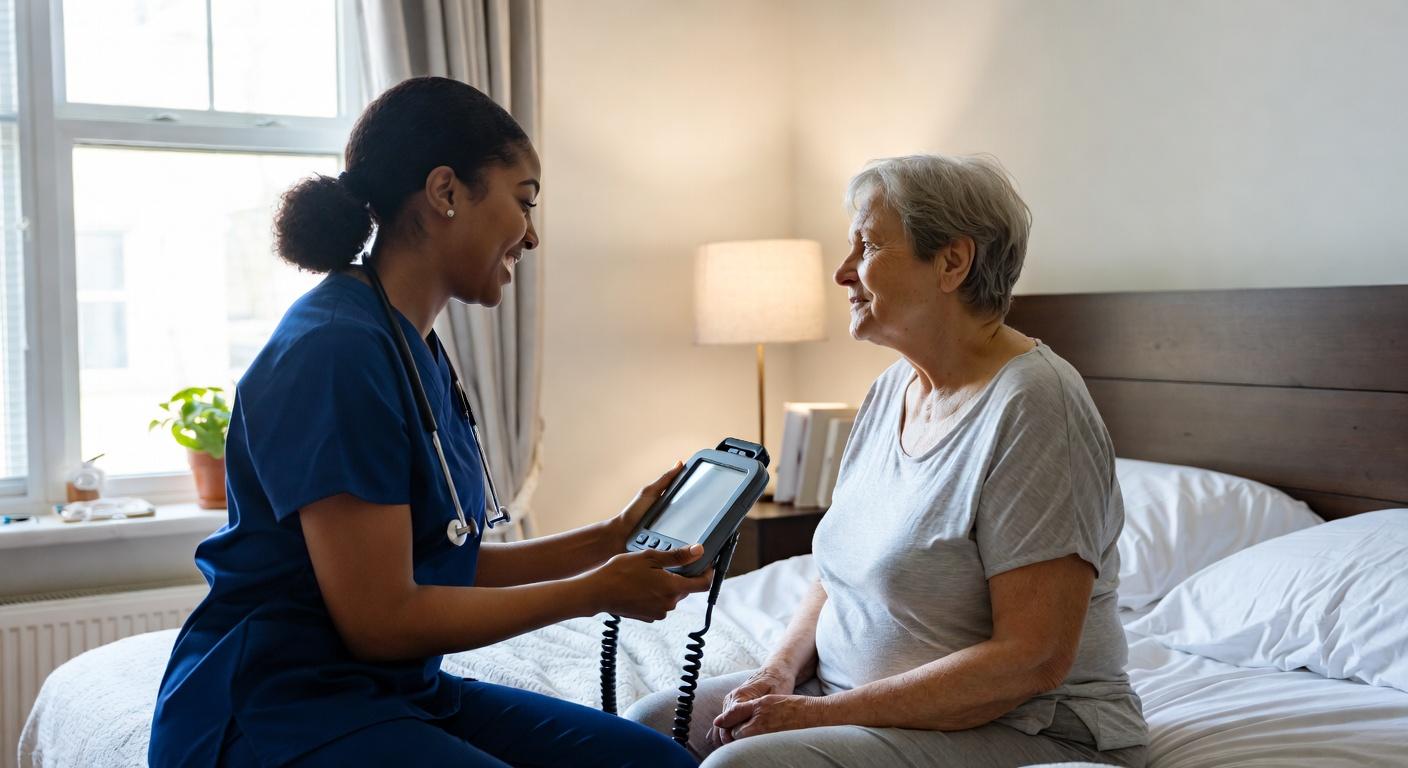
What if your parent could recover from surgery in their own bed, with nurses visiting daily and doctors checking in via video? What if a hospital stay didn't mean fluorescent lights and mystery meals, but your own room, your own food, your own dog at your feet?
That's not a future fantasy. It's happening now.
And according to PwC, it's just the beginning of a $1 trillion shift in how healthcare is delivered.
The Numbers Don't Lie
According to PwC's Future of Health report:
- $5 trillion: Current annual US healthcare spending (18% of GDP)
- $9 trillion: Projected spending by 2035 without intervention
- 25%: Share of healthcare costs going to administrative overhead
- 90%: Share of costs attributed to chronic and mental health conditions
- $239 billion: Projected US home healthcare market by 2030
And the prediction that changes everything:
"Within the next 10 years, the traditional infrastructure-heavy model will be replaced by a distributed, tech-enabled system that delivers care anywhere, anytime—with most care moving into the home."
Read that again. Most care moving into the home.
Why Home Beats Hospital (Usually)
Better Outcomes
Studies consistently show that for appropriate conditions, patients recover better at home:
- Lower infection rates (your germs, not the hospital's)
- Better sleep (your bed, your schedule)
- Reduced confusion (familiar environment)
- Higher satisfaction (obviously)
- Lower readmission rates
Lower Costs
Hospital care is extraordinarily expensive:
| Setting | Approximate Daily Cost |
|---|---|
| Hospital ICU | $5,000-10,000+ |
| Hospital general | $2,500-3,500 |
| Skilled nursing | $250-400 |
| Home care with nursing | $150-300 |
| Standard home care | $100-200 |
Moving appropriate care home doesn't just help patients—it makes the math work for a healthcare system that's spending itself into crisis.
Patient Preference
When asked, patients overwhelmingly prefer home. Given equal outcomes, who wouldn't choose recovery in their own space with their own people?
Hospital-at-Home: How It Actually Works
Hospital-at-home programs provide acute hospital-level care in the patient's residence. Here's a typical scenario:
Day 1:
- Patient goes to ER with pneumonia
- Instead of admission, evaluated for hospital-at-home eligibility
- If appropriate, sent home with equipment and treatment plan
- Nurse visits within hours to set up IV antibiotics, monitoring equipment
Days 2-5:
- Twice-daily nurse visits
- Daily video check-ins with physician
- Continuous monitoring via wearables (oxygen, heart rate, temperature)
- IV antibiotics, respiratory treatments, all at home
- 24/7 access to medical team via phone/video
Outcome:
- Same treatment as hospital
- Same (or better) outcomes
- Much better experience
- Significantly lower cost
According to the American Association of Nurse Practitioners, Medicare coverage for hospital-at-home continues to expand in 2026.
The Technology Making It Possible
Wearables as Medical Devices
Your parent's Apple Watch isn't just a fitness tracker anymore:
- Continuous heart monitoring
- Blood oxygen tracking
- Fall detection
- ECG capability
- Sleep analysis
When these devices feed data to care teams, they enable monitoring that rivals—sometimes exceeds—what's possible in a hospital.
Smart Home Integration
According to Healthcare IT Today, smart homes in 2026 function as continuous health monitors:
- Motion sensors tracking activity patterns
- AI detecting behavioral changes that may indicate problems
- Medication dispensers tracking adherence
- Environmental sensors monitoring temperature, air quality
- Integration with wearables for complete picture
Virtual Care Centers
The most exciting development: virtual command centers that orchestrate home care.
Imagine a control room where nurses monitor dozens of patients simultaneously via:
- Real-time wearable data streams
- Smart home sensors
- Video check-in capabilities
- AI-powered alerts for concerning changes
When a patient's oxygen drops, the system flags it. A nurse reviews within minutes. If intervention is needed, a mobile team is dispatched—or the patient is directed to emergency care.
It's like air traffic control for healthcare.
AI Everywhere
AI is transforming every part of home care:
- Predictive analytics: Identifying who's likely to decline before it happens
- Natural language processing: Documentation in seconds from voice input
- Image analysis: Wound monitoring from smartphone photos
- Risk stratification: Targeting resources where they're most needed
According to PwC, AI will help physicians evolve from administrators drowning in paperwork to "data-orchestrators" focused on actual care decisions.
The $1 Trillion Shift
PwC projects a massive reallocation of healthcare spending by 2035:
Spending moving AWAY from:
- Brick-and-mortar facilities
- Administrative overhead
- Episodic reactive care
- Paper-based processes
- Redundant testing and documentation
Spending moving TOWARD:
- Home-based care delivery
- Continuous remote monitoring
- AI-enabled predictive intervention
- Precision medicine
- Preventive and proactive approaches
This isn't incremental change. It's a fundamental restructuring of how care is delivered.
What This Means for Families
More Care at Home
If your loved one needs care, more of it will happen at home:
- Post-surgical recovery
- Chronic disease management
- Rehabilitation
- Even some acute conditions
Home will be the default, not the exception.
Technology as Care Partner
The technology in this article isn't optional—it's becoming standard of care:
- Wearables for monitoring
- Voice assistants for accessibility
- Smart homes for safety
- Video for medical consultations
Embracing technology isn't about being cutting-edge. It's about accessing the care model of the future.
Visibility Becomes Essential
Here's the thing about distributed care: someone needs to see it all.
When your loved one receives:
- Hospital-at-home from one provider
- Regular home care from a provider
- Physical therapy from another provider
- Family support from you
Who has the complete picture?
Care coordination becomes critical. Visibility across providers becomes essential.
What This Means for Agencies
If you run a home care provider, this trend is your future.
Opportunity
The market is growing to $239 billion. Demand for home-based care will only increase.
Agencies positioned for this shift will thrive:
- Technology-enabled operations
- Integration with healthcare systems
- Quality documentation and outcomes tracking
- Scalable, efficient processes
Challenge
Competition will intensify. Healthcare systems are building home care capabilities. Technology companies are entering the space.
To compete, agencies need:
- EVV compliance that's bulletproof
- Documentation that proves quality
- Efficiency that enables competitive pricing
- Technology that healthcare partners expect
Evolution
The home care provider of 2030 looks different than today:
- Integrated with hospital-at-home programs
- Real-time data sharing with healthcare systems
- AI-assisted care planning
- Outcome-based reimbursement
- Technology-first operations
Agencies that adapt will be essential parts of the care ecosystem. Those that don't will be replaced.
CareCade's Role in the Future of Care
We're not building a wearable. We're not building a virtual hospital. We're not replacing professional medical care.
We're building the verification layer that makes distributed care work.
The Visibility Problem
As care distributes across more settings and providers, a critical question emerges:
How do families, case managers, and healthcare systems know care is actually happening?
The hospital has nurses rounding. The nursing home has staff on-site. But home care?
Without verification, home care is invisible. And invisible care creates:
- Family anxiety
- Case manager uncertainty
- Healthcare system distrust
- Quality concerns
The CareCade Solution
We make home care visible:
- GPS-verified visits: Proof that caregivers arrived and stayed
- Activity documentation: Evidence of what happened during visits
- Goal tracking: Progress over time, not just point-in-time snapshots
- Real-time notifications: "On My Way" alerts, visit confirmations
- Family Portal: Visibility for families without phone calls
- Case Manager Dashboard: Monitoring across providers
In a world where most care happens at home, knowing that care happens becomes essential infrastructure.
The Integration Future
As healthcare systems embrace home-based care, they'll need verification partners:
- Hospital-at-home programs need to know their mobile nurses visited
- Accountable care organizations need to track post-discharge care
- Managed care plans need to verify services they're paying for
- Quality programs need outcome data
CareCade is building toward that future—not just family visibility, but healthcare system integration.
The Vision: 2030 and Beyond
Imagine:
Your parent has a chronic condition requiring ongoing management.
Their care includes:
- Continuous monitoring via wearables
- Smart home safety features
- Weekly nurse visits (hospital-at-home program)
- Daily caregiver support (CareCade-verified agency)
- Monthly video visits with specialists
- AI-powered early warning system
As their adult child, you see:
- Health metrics trending positively
- Care visits verified and documented
- Goals being met
- Alerts when something needs attention
- Communication with the care team
You feel:
- Connected, not worried
- Informed, not in the dark
- Supportive, not overwhelmed
- Present, even from a distance
That's the future of home care. Technology enabling human connection. Distributed care that's coordinated. Visibility that creates peace of mind.
It's not science fiction. Every piece of this exists today. The question is just how fast it comes together.
Getting Ready for the Shift
For Families
- Embrace technology: Wearables, voice assistants, smart home basics
- Build care relationships: Find agencies and providers you trust
- Establish visibility: Know how you'll stay informed about care
- Understand benefits: WA Cares, Medicare, Medicaid options
- Plan proactively: Don't wait for crisis to figure out care
For Agencies
- Invest in technology: EVV, documentation, scheduling
- Build healthcare relationships: Position for integration
- Focus on quality: Outcomes matter more than ever
- Train teams: Technology fluency is essential
- Think long-term: The winners in 2030 are investing now
For Everyone
The future of healthcare is coming home.
Those who prepare—families, providers, systems—will thrive in a world where care is distributed, monitored, and verified.
Those who don't will find themselves in a healthcare system that's moving faster than they can adapt.
The shift is happening. The question is whether you're ready.
Be There for What's Next
We named our company around a simple idea: Be there for the care that matters.
As care moves home, "being there" means something new:
- Being there through technology when you can't be there in person
- Being there through verification when you can't witness care yourself
- Being there through connection when distance separates you
- Being there through visibility when care is distributed
The future of care is home. CareCade is building the infrastructure to make it visible.
$239 billion by 2030. $1 trillion shift by 2035. Most care moving home within a decade.
The future isn't coming. It's here.
Be ready.